What Size Generator Do I Need for Tailgating?
Finding the Right Power Setup for Game Day
Game day isn’t just about the four quarters on the field; it is about the three hours of pre-game anticipation in the stadium parking lot. You have the prime spot, the smoker is loaded, and the tailgate crowd is arriving. But the moment you plug in your blender, slow cooker, speakers and flat-screen TV simultaneously, the power cuts out. The silence that follows is the ultimate buzzkill.
Choosing the right size portable generator transforms your parking space into a fully functional outdoor living room. The secret isn’t buying the largest, loudest machine on the market—it is about matching your power supply to your specific gear. Whether you are running a minimalist setup for a few friends or hosting an engine-roaring stadium tailgate party for twenty, finding the right power balance ensures your drinks stay cold, your food stays hot, and the pre-game coverage never flickers.
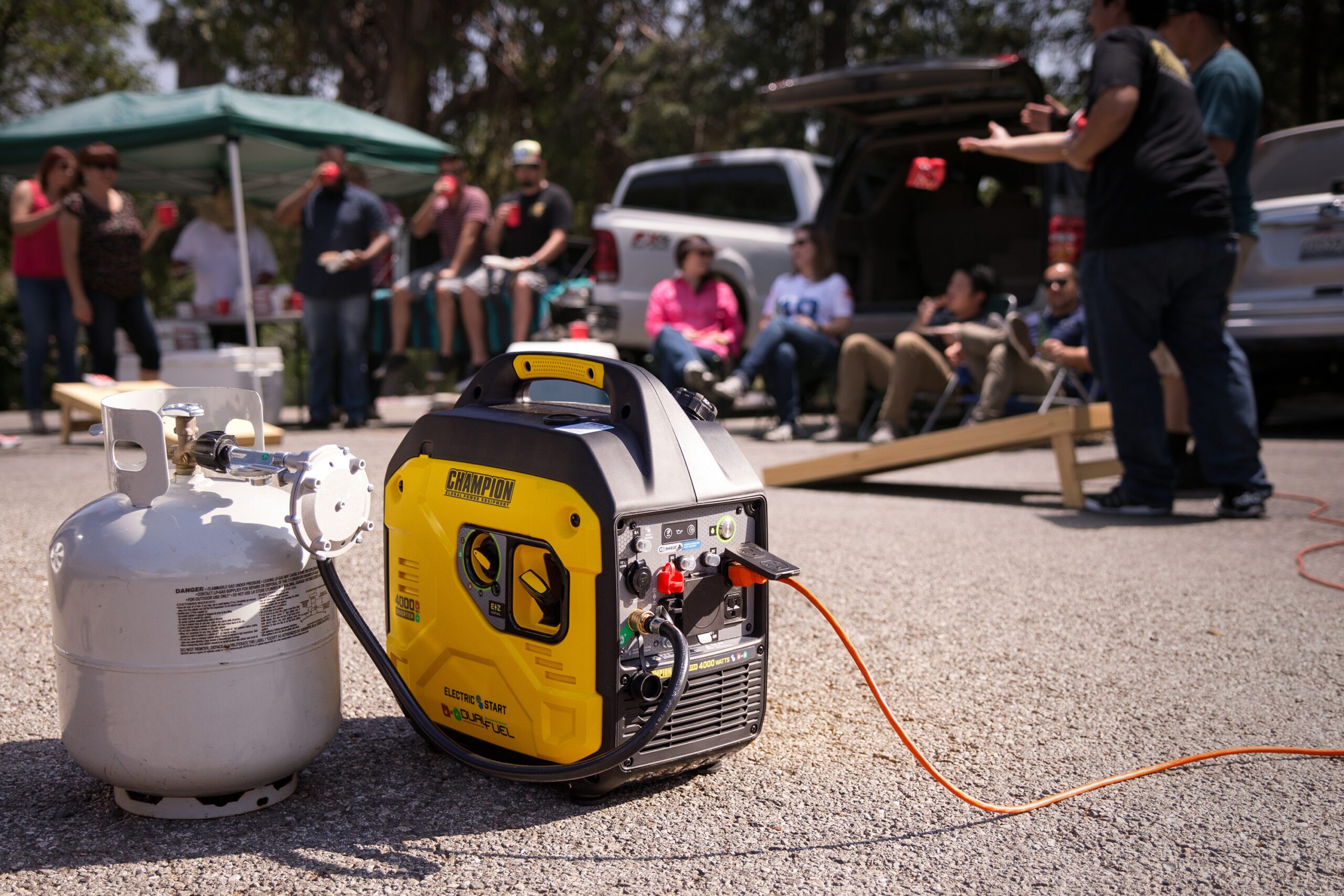
How Many Watts Do You Actually Need for Tailgating?
Generator power is measured in watts. To pick the right unit, you need to understand how your intended setup translates into power consumption. Tailgate setups generally fall into three distinct categories based on scale and energy demands.
Tailgate Power Sizing Guide
| Setup | Wattage | Recommended Equipment |
|---|---|---|
| Small Setup | 1,000–2,000 Watts | Small TV, LED Lights, Phone Chargers, Bluetooth Speaker |
| Medium Setup | 2,000–3,500 Watts | 55″+ TV & Soundbar, Electric Griddle, Blender / Slow Cooker, Mini-Fridge |
| Large Setup | 3,500+ Watts | Dual Refrigerators, Electric Smokers, Portable AC / Heater, Full PA System |
Small Setup: Quiet, Essential Power (1,000 to 2,000 Watts)
If your game-day philosophy centers on simplicity, a compact inverter generator producing between 1,000 and 2,000 watts is your sweet spot. This category is built for the minimalist who relies on traditional charcoal or propane for cooking but needs reliable electricity for entertainment and light utility.
With 2,000 watts, you can effortlessly run a 43-inch LED television, a couple of phone chargers, a Bluetooth speaker, and a string of overhead LED lights. These generators are lightweight and quiet, making them easy to carry with one hand while leaving plenty of room in your trunk for cooler space.
Medium Setup: The Crowd Favorite (2,000 to 3,500 Watts)
The 2,000 to 3,500-watt range represents the sweet spot for most seasoned tailgaters. This power class bridges the gap between basic electronics and high-draw heating appliances.
In this tier, you can comfortably run a mid-sized television, a soundbar, a mini-fridge, and high-draw kitchen equipment like a electric grill or a margarita blender. You can chop, mix, and warm food without having to unplug the TV to do it.
Large Setup: The Ultimate Stadium Party (3,500+ Watts)
When your tailgate turns into a neighborhood block party, a 3,500-watt or larger generator becomes mandatory. This is the domain of high-end setups featuring large pellet grills, electric griddles, commercial-grade blenders, dual tailgating TVs, and portable space heaters or misting fans to handle extreme weather.
Units in this class deliver serious muscle, allowing you to run multiple heavy-draw heating elements at the same time. While these generators are heavier they eliminate the need to constantly monitor what is plugged in. They allow you to operate your tailgate lot just like your home living room.
How to Calculate Your Tailgate Wattage Requirements
Avoid guessing your power requirements hours before kickoff. Calculating your exact wattage needs is a straightforward process that prevents tripped breakers and damaged appliances.
Use the following formula when wattage isn’t listed:
- Volts (V) × Amps (A) = Watts (W)
1. Check Running Watts vs. Starting Watts
Every electronic device uses two distinct power metrics: running watts (the continuous power required to keep the device operating) and starting watts (the brief surge of power required to turn on electric motors or compressors).
A standard 50-inch LED TV requires about 100 running watts and virtually no extra starting watts. Conversely, a mini-fridge might require 100 running watts, but demands 400 starting watts for two seconds when the compressor kicks on. You can locate these numbers on the electrical label on the back or bottom of your appliances.
2. Add Up Your Peak Appliance Loads
To find your baseline requirement, list all the devices you plan to run simultaneously. Sum up their running watts. Next, identify the single appliance with the highest starting wattage surge. Add that surge differential to your total running wattage.
For instance, if you are running a TV (100W), an electric griddle (1,500W), and a mini-fridge (100W running / 400W starting), your baseline running total is 1,700 watts. Since the mini-fridge requires a 300-watt surge over its running capacity, your peak load requirement jumps to 2,000 watts.
3. Leave a Safe Buffer Margin
Never operate a generator at 100% of its rated capacity for extended periods. Running an engine at its absolute limit causes excessive heat, spikes fuel consumption, increases noise, and shortens the machine’s lifespan.
Apply a 20% safety margin to your final calculation. If your peak load calculation comes out to 2,000 watts, multiply that number by 1.20 to get 2,400 watts. Target a generator rated for at least 2,400 continuous running watts to handle unexpected load spikes without interrupting the tailgate.
Common Tailgate Appliances and Their Wattage Demands
Understanding the typical energy footprint of standard tailgating equipment helps you build a balanced setup. Cooking devices that generate heat always consume vastly more electricity than visual displays or audio equipment.
| Tailgate Appliance | Average Running Watts | Average Starting Watts | Power Category |
|---|---|---|---|
| 55-inch LED TV | 100–150 W | 100–150 W | Low Draw |
| Speaker System | 50–200 W | 100–400 W | Low to Moderate |
| Pellet Grill / Smoker | 250 W (Ignition) / 50 W (Running) | 600 W | Low to Moderate |
| Mini-Fridge | 100–150 W | 400–500 W | Moderate Surge |
| Tailgate Blender | 300–600 W | 600–900 W | Moderate Surge |
| Crock-Pot / Slow Cooker | 200–400 W | 200–400 W | Moderate Draw |
| Electric Griddle | 1,200–1,800 W | 1,200–1,800 W | High Continuous Draw |
| Portable Electric Heater | 1,500 W | 1,500 W | High Continuous Draw |
If you plan to cook using electricity, your generator size will immediately skew larger. Heating elements like electric griddles act as massive energy sponges, demanding almost the entire output of a basic 2,000-watt generator by themselves.
Key Features to Look For in a Tailgating Generator
Not every generator is suited for a tailgate lot. The crowded, social environment of a stadium parking lot requires specific design features focused on safety, efficiency, and comfort.
Essential Tailgate Generator Features
| Feature | Benefit |
|---|---|
| Quiet Inverter | Keeps noise under 60 dBA |
| Clean Power / Pure Sine Wave | Protects phones & smart TVs |
| Multi-Fuel Capability | Provides gas or propane flexibility |
| Compact Frame / Wheels | Enables easy one-person setup |
Noise Level Restrictions and Courtesy
Traditional open-frame standard portable generators sound like lawnmowers running at full throttle, producing upwards of 75 to 80 decibels (dBA). In a crowded parking lot, a loud generator ruins conversation and violates stadium guidelines.
Look for enclosed inverter generators rated at 50 to 65 dBA at a quarter-load. At this sound level—roughly equivalent to a normal conversational tone—you can comfortably chat, listen to the game commentary, and keep your parking lot neighbors happy.
Inverter Technology for Sensitive Electronics
Modern tailgates rely heavily on sensitive microprocessors housed in smart TVs, laptops, soundbars, and smartphones. Standard portable generators produce electricity with high total harmonic distortion (THD), which can overheat or permanently fry delicate circuit boards.
Always select an inverter generator that delivers clean power with less than 3% THD (pure sine wave). Inverter technology electronically refines raw power, ensuring the voltage supplied to your $1,000 television is as stable as the power coming from your home wall outlets.
Fuel Type and Run Time Efficiency
When choosing a fuel source, look for models featuring dual-fuel capability (gasoline and propane). Propane burns cleaner, stores indefinitely without gumming up carburetors, and eliminates the mess of pouring liquid gasoline near open flames or hot engine parts.
Additionally, check the generator’s run time at 25% or 50% load. A quality tailgating unit should run for at least 6 to 8 hours on a single tank, allowing you to power through pre-game festivities, the game itself, and post-game traffic without refueling mid-party.
Portability and Weight Factors
A generator’s convenience is directly proportional to how easily you can load it into your vehicle. Units under 2,000 watts usually feature suitcase-style top handles and weigh around 40 to 50 pounds, making them easy for a single person to lift into a truck bed or SUV trunk.
If you scale up to a 3,500-watt unit weighing 80 to 110 pounds, prioritize models that include built-in wheel kits and handles. Trying to drag a wheel-less 100-pound generator across a gravel lot on game morning is a recipe for back strain before the game even starts.
Frequently Asked Questions
How far should I place my generator from my tailgate setup? Always place a gas generator at least 20 feet away from your setup, vehicle, and canopy, with the exhaust pointed away from windows, doors, or vents of any kind. Never operate a generator inside a capped truck bed or underneath an enclosed tent. ALWAYS operate it OUTDOORS, on a flat, level surface, with at least five feet of clearance on all sides.
What type of extension cord should I use with my generator? Use 10-gauge or 12-gauge, heavy-duty, weather-resistant extension cords rated for outdoor use. Long, thin cords can cause voltage drops, overheat appliances, and trip your generator’s breakers.
How should I protect electrical connections at a tailgate? Keep plug connections elevated and away from standing water caused by rain, melted ice, or spills. Use cord safety covers, wooden blocks, or another stable elevated surface to help prevent short circuits and ground faults.
Can I connect two inverter generators to get more power? Yes, if your inverter generators are parallel-ready and compatible. Connecting two identical 2,000-watt inverter generators with an approved parallel kit can provide up to 4,000 watts of combined power output, giving you additional power while keeping your setup portable.
How long should I wait before refueling my generator? Always turn the generator off and allow it to cool before refueling. Never add gasoline to a hot or running generator. Allow the unit to cool for at least 10 minutes and refuel away from open flames, hot grills, and other ignition sources.
Need Help Finding the Right Generator?
From calculating your wattage needs to choosing the right features for your tailgate setup, finding the right generator can feel like a lot to tackle. If you’re still unsure which Champion generator is right for your game-day setup, our Customer Support team is here to help. Reach support by phone or live chat, or visit the Help Center for easy-to-follow guides and self-service tools. You can also visit our YouTube channel for tutorials and helpful videos to get the most out of your Champion equipment.